Explaining Trajectory Patterns in Long-Term Behavioural Data
Demonstrating how explainability clarifies time-based segmentation models.
The challenge
Long-term behavioural and financial datasets often produce trajectory groups — patterns such as “stable,” “declining,” or “boom-to-bust.” But the logic behind these groups is typically opaque. Teams struggle to understand what signals define each pattern, why trajectories diverge, and how sensitive the groupings are to small changes in the data.
This case study shows how WhiteBox applies its framework to a real multi-year dataset to make time-based segmentation transparent and defensible.
Our approach
WhiteBox applied an end-to-end transparency framework combining three lenses:
1. Attribution analysis
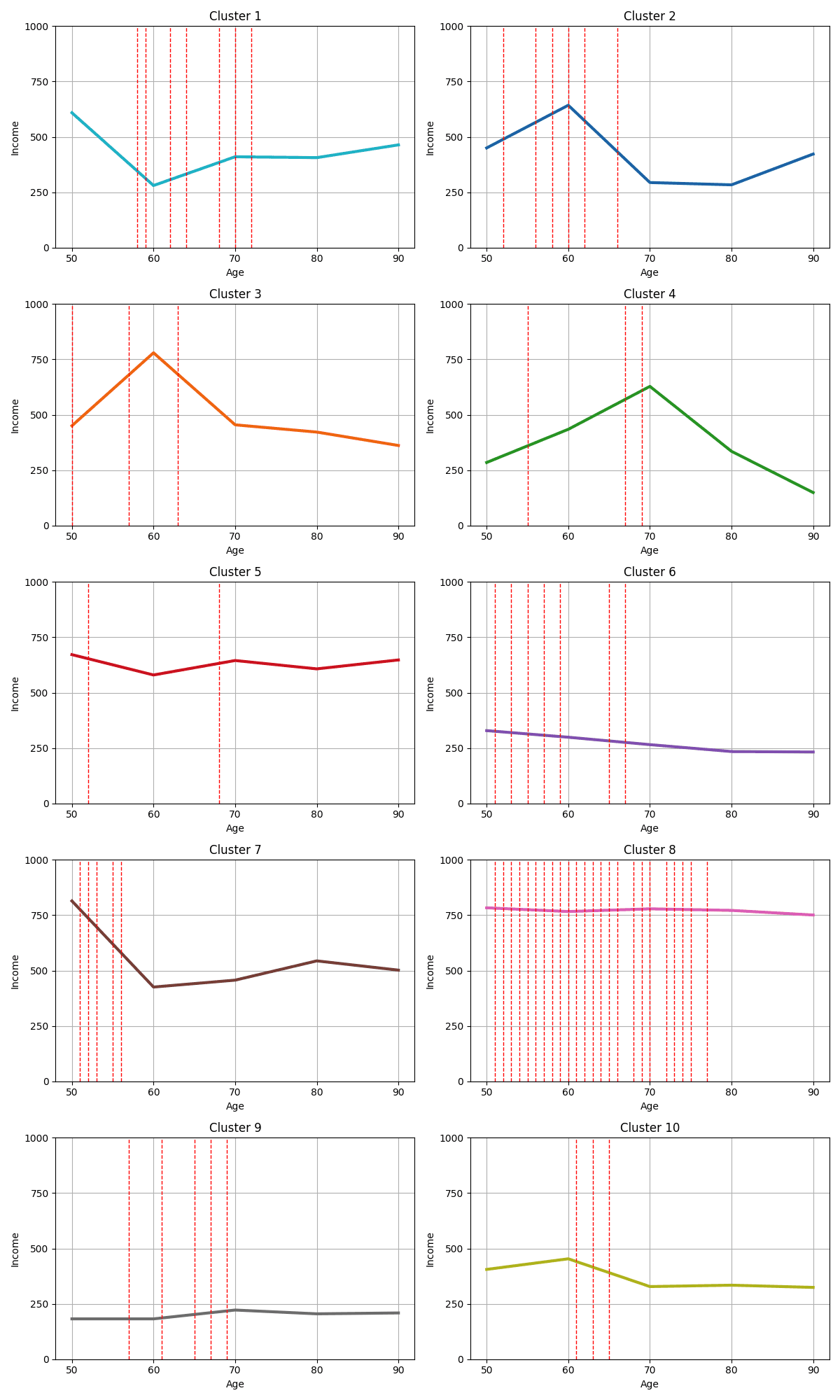
Reveals which ages/time-points had the strongest influence on a cluster assignment — the attribution map.
2. Counterfactual analysis
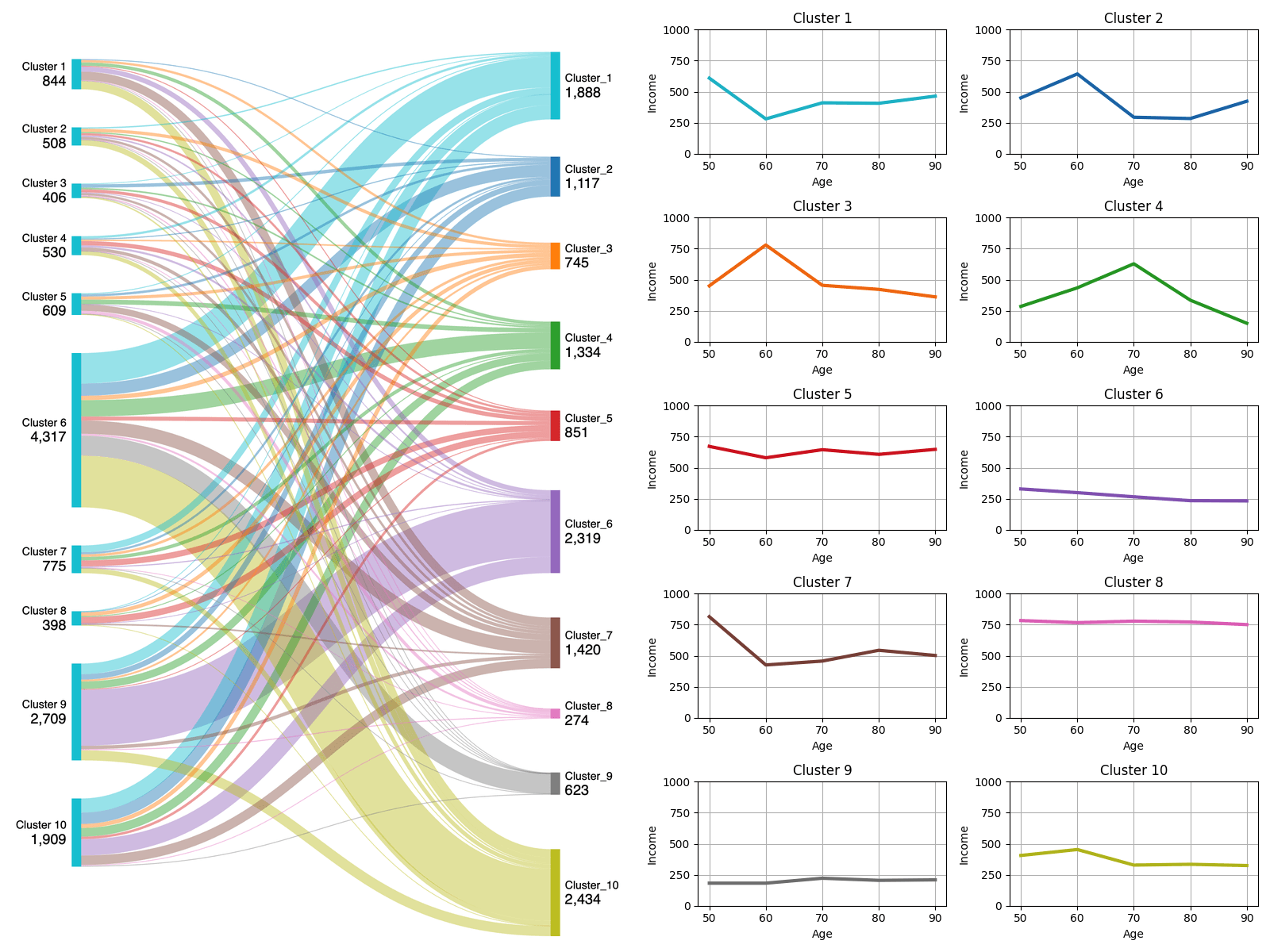
Tests how small changes to a trajectory would shift it into a different group — the mobility map.
3. Temporal similarity review
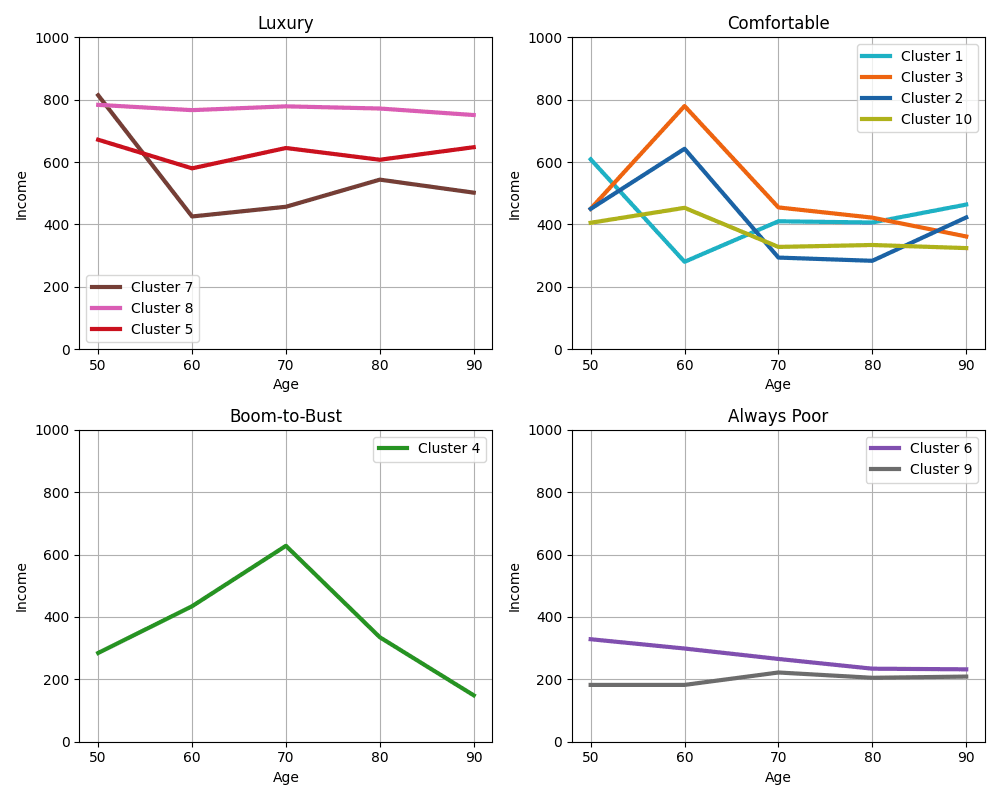
Compares average cluster shapes to see which groups behave similarly over time — the cluster signature map.
Together, these methods provide local interpretability (Why this trajectory?) and global interpretability (How does the system behave overall?).
Key findings
1) A small number of time-points define each group
Most clusters were driven by just 2–5 critical ages, with some stable or high-income patterns shaped by broader spans. This revealed strong early anchors, weaker late-life influence, and hidden structure not visible in the original model.
2) Trajectories are highly mobile under small changes
Counterfactuals showed that adjusting 1–2 values often shifted a trajectory into a neighbouring cluster, indicating less stability than assumed and boundaries that many individuals could cross.
3) Cluster relationships differ from the original categorisation
Flow patterns exposed surprising similarity: some “Always Poor” groups did not cluster together, while certain “Comfortable” and “Luxury” segments behaved more alike than expected. One group acted as a central attractor.
4) A new explainability-driven grouping emerged
Using counterfactual mobility as a distance measure produced an alternative hierarchy that reflected how people actually transition between patterns, rather than predefined labels.
Why it matters
- Why distinct behavioural patterns emerged.
- Which early-life signals drive long-term outcomes.
- How fragile or robust each cluster is under change.
- Hidden similarities between seemingly different groups.
- How to reinterpret segmentation using transparent evidence.
This clarity supports risk and compliance, forecasting, targeted interventions, resource allocation, and audit.
Outcome
WhiteBox delivered concise visuals: the trajectory signature map (cluster shapes over time), attribution map (critical time-points per cluster), and mobility map (counterfactual flows between groups). The black-box segmentation became a transparent, defensible decision-support tool. Leadership gained a clear view of how long-term patterns form — and how to influence them.